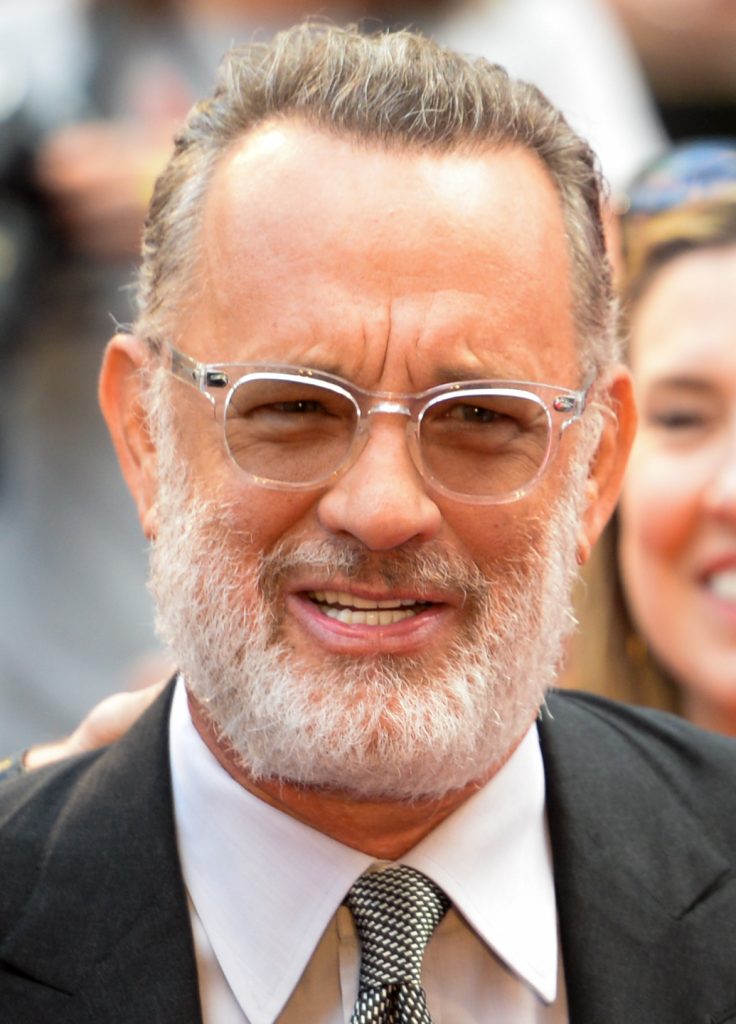
He is the most trusted man in America who isn’t actually anyone’s dad. Polls have said it for years: if Tom Hanks tells you something, you believe him. That trust wasn’t manufactured by a studio. It was built, film by film, over nearly five decades — by an actor who made decency look like the hardest craft in Hollywood.
Born July 9, 1956, in Concord, California, Thomas Jeffrey Hanks had a fractured childhood — his parents divorced when he was five, and he shuttled between households. He has described himself as a shy, awkward kid. What saved him was a high school production of The Mouse That Roared. He caught the acting bug so completely that he dropped out of college to intern at a Shakespeare festival in Ohio, hauling sets and learning the trade from the ground up.
The Class Clown
Hollywood first met him as a goofball. Bosom Buddies (1980–82), a sitcom about two men dressing as women to live in cheap housing, was disposable television — but Hanks was undeniably alive in it. A string of lightweight comedies followed until Big (1988), where he played a boy trapped in a man’s body and earned his first Oscar nomination. He was funny. Nobody yet thought he was important.
The Turn Nobody Saw Coming
Then, in the span of two years, he did something only one actor had ever done before.
As a lawyer dying of AIDS in Philadelphia (1993), Hanks stripped away every comic tic and won the Academy Award for Best Actor. The very next year, as Forrest Gump (1994), he won it again — back-to-back Best Actor Oscars, a feat achieved only once before, by Spencer Tracy in the 1930s. The clown had become the conscience of American movies, and he’d done it without a trace of vanity. His Oscar speech for Philadelphia, thanking his gay high school drama teacher, was itself a small act of courage on live television.
The Everyman Era
What followed was the most reliable two decades in modern film: Apollo 13 (1995), Saving Private Ryan (1998), You’ve Got Mail (1998), The Green Mile (1999), Cast Away (2000) — for which he lost fifty pounds and talked to a volleyball — and Woody, the pull-string cowboy of Toy Story (1995), a role he has now played across thirty years. He became the man you cast when the story needs someone the audience will follow anywhere: into war, into space, onto a desert island.
Nice as Discipline
The “nicest guy in Hollywood” reputation could have been a trap — a brand that sanded off his edges. Instead, Hanks treated it as a discipline. The stories are legion and remarkably consistent across decades: the returned lost credit cards, the wedding photos crashed with grace, the crew members who say he knows everyone’s name. He collects typewriters. He is obsessed with World War II history. He writes essays. None of it feels performed, which may be the most Hanks-like quality of all: the total absence of calculation.
Why Tom Hanks Matters Now
At seventy, he occupies a position no actor has held quite this way before — not the biggest star, not the most decorated, but the most believed. In an era of synthetic everything, there is something almost radical about a career built on the proposition that sincerity is a skill and kindness is a choice you make daily, on camera and off.
Most actors play heroes. Tom Hanks spent fifty years making audiences believe he might actually be one.
Photo: Aiksu / Wikimedia Commons / CC BY 2.0 (File: Tom Hanks TIFF 2019.jpg)
Leave a Reply