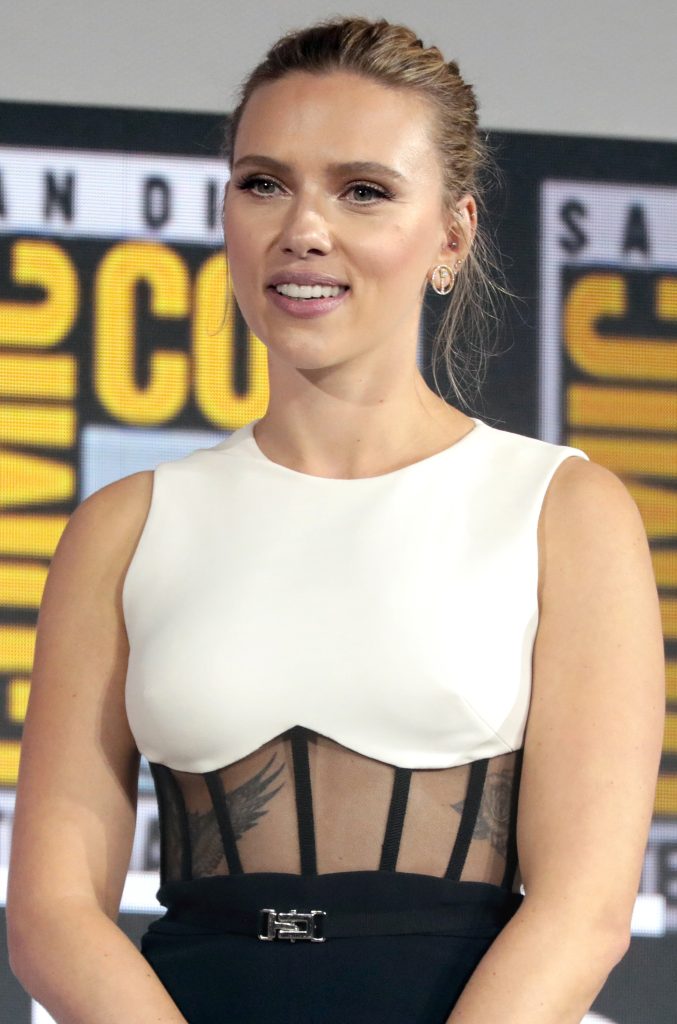
In the summer of 2025, Scarlett Johansson did something no actor in the history of cinema had ever done. When Jurassic World Rebirth finished its theatrical run at $869 million worldwide, her career box-office total pushed past $14.8 billion — lifting her above Samuel L. Jackson and Robert Downey Jr. to the very top of the all-time rankings. She had done it in just 36 films. Asked how it felt to be the highest-grossing actor who ever lived, she brushed it off as temporary.
That shrug is pure Johansson. For three decades she has treated the biggest machinery in Hollywood as something to use rather than something to serve — and the industry keeps rewarding her for it.
Born on November 22, 1984, in Manhattan, New York City, Scarlett Ingrid Johansson arrived alongside her twin brother, Hunter, to a producer mother and an architect father. Her parents divorced when she was thirteen, and her mother managed her early career, steering her toward auditions while she was still in elementary school.
A Child Actor Who Refused to Stay One
Johansson made her film debut at nine in Rob Reiner’s 1994 comedy North. Two years later she carried Manny & Lo, a small indie about two runaway sisters, earning an Independent Spirit Award nomination. Then came The Horse Whisperer in 1998, where Robert Redford cast her as the injured teenager at the story’s center — the first time a mass audience saw her.
What separates her from nearly every other child actor of her generation is what happened next. Instead of aging into teen franchises, she chose strange, grown-up parts. She was building a résumé that looked nothing like a child star’s — because she had already decided she wasn’t going to be one for long.
Lost in Translation
Everything changed in 2003. At eighteen, Johansson played Charlotte, the neglected young wife wandering Tokyo, opposite Bill Murray in Lost in Translation — winning the BAFTA for Best Actress. The same year she starred in Girl with a Pearl Earring as the maid who becomes Vermeer’s muse. Two prestige pictures in twelve months, both built around her face and her silences. Hollywood had a new serious actress, still a teenager.
Becoming Black Widow
In 2010, Johansson won the role of Natasha Romanoff in Iron Man 2 after Emily Blunt withdrew over scheduling conflicts — dyeing her hair red to convince director Jon Favreau, then throwing herself into stunt training. The character could have been decoration. Instead, across nine Marvel films, she made Black Widow the connective tissue of the franchise, culminating in Avengers: Endgame, one of the highest-grossing films ever made.
The Marvel years made her the most bankable woman in the industry — Forbes named her the world’s highest-paid actress in both 2018 and 2019. And while carrying the franchise, she kept one foot in prestige cinema: in 2020 she earned two Academy Award nominations in the same year, Best Actress for Marriage Story and Best Supporting Actress for Jojo Rabbit. A 2010 Tony for her Broadway debut in A View from the Bridge and two albums as a singer rounded out a résumé that refused to fit in one box.
The Lawsuit That Changed the Streaming Era
In 2021, Disney released her long-delayed solo film Black Widow simultaneously in theaters and on Disney+ Premier Access. Johansson’s pay was tied to box-office performance, so in July 2021 she sued Disney for breach of contract — one of the first times an A-list star had publicly taken the world’s biggest studio to court over streaming-era pay. The two sides settled that September on undisclosed terms, and Johansson kept working with Disney afterward. But the message landed: talent would not accept old contracts in the new distribution world, and streaming compensation soon became standard negotiating territory for every major star.
The $15 Billion Summer
Then came 2025. Cast as mercenary Zora Bennett in Jurassic World Rebirth — directed by Gareth Edwards, co-starring Jonathan Bailey and Mahershala Ali — Johansson fronted a franchise reboot with no returning characters. It opened to $318 million worldwide in its first five days and closed at $869 million, the sixth-highest-grossing film of the year.
The run pushed her career total past $15 billion, making her the first actor in history to cross that line and placing her at number one on the all-time box-office chart. In the same season, her directorial debut, Eleanor the Great — starring June Squibb — premiered at the Cannes Film Festival. Acting milestone and directing debut, within weeks of each other, at forty.
Off screen, her personal life has been lived largely in public: a marriage to Ryan Reynolds from 2008 to 2011, a second marriage to Romain Dauriac from 2014 to 2017 with whom she shares a daughter, and since 2020 a marriage to comedian Colin Jost, with whom she welcomed a son in 2021.
Why Scarlett Johansson Matters Now
Plenty of actors have had a hit. Almost none have survived every phase of the modern industry and come out with more leverage than they started with. Johansson outlasted child stardom without a tabloid spiral, carried the biggest franchise on earth without being swallowed by it, and sued the most powerful studio in Hollywood over the future of compensation — winning the settlement and keeping the relationship. Then, at an age when the industry historically starts sidelining actresses, she became the highest-grossing actor of all time and directed her first feature.
The $15 billion is the receipt. The real story is three decades of refusing to be only one thing — and being right every time.
Photo: Gage Skidmore, via Wikimedia Commons (CC BY-SA 2.0).
https://commons.wikimedia.org/wiki/File:Scarlett_Johansson_by_Gage_Skidmore_2_(cropped).jpg

Leave a Reply